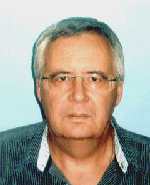
Mayer Aladjem 
Associate Professor of Electrical & Computer Engineering


He joined the ECE department at Ben-Gurion University in 1991.  

Research Interests:  
Statistical pattern recognition.  
Neural networks for pattern recognition.  
Multivariate Density Estimation.  
Blind Source Separation.  
Independent Component Analysis.  
Support vector machines and kernels.  
Ensemble Methods.  
Feature extraction, reduction, and analysis.  
Applications in signal and image processing.  

Address:  
Ben-Gurion University of the Negev,  
Department of Electrical and Computer engineering,  
P.O.Box 653,  
Beer-Sheva, 84105, Israel


                             E-mail: aladjem@ee.bgu.ac.il

                            Research Lab: Pattern Recognition and Intelligent Data Analysis (PRIDA)
                      (The Lab supports the research of the graduate students in various fields of ECE specializations )

                        PhD and M.Sc. students, Theses (and journal publications with my students,Full Text Access)
                        (currently 3 PhD and 5 M.Sc. students, and 20 former graduated students)

                        Publications(1991-Present, Full Text Access) in: Journals   Conference proceedings

                        Courses: Graduate level   Undergraduate level
Graduate Courses (2012/13)
Pattern Recognition
Neural Networks for Pattern Recognition – Statistical foundation, perspective and alternatives.


                        Additional Information: Editor  
Chairman   Lectures   Committees

                           Synopsis of Research   (This part is in reconstruction and extension)

· Novel discriminant criteria
· Interactive system for exploratory data analysis
· Method for estimating the significance of the control parameters of projection procedures
· Multiclass discriminant projections
· New methods for successive optimization of the discriminant criteria
· Comparative study of neural networks for multivariate data projection
· Discriminant analysis via neural network reduction of the class separation